Originally raised in Ceylon (now Sri Lanka) in 1900, although based on a tradition of volunteer rifle service that dated back to the 1860s. Headquartered at Kandy and voluntarily manned by Europeans with connections to the tea-growing industry. The Corps sent a detachment to serve in South Africa during the Second Boer War and earned the battle honour “South Africa 1900”. By the end of the war, some 700 men had volunteered for the Corps, including about 50% of all of the islands tea planters. It was an addition to the existing Ceylon Artillery Volunteers, Ceylon Volunteer Medical Corps, Ceylon Mounted Infantry and Ceylon Light Infantry: only the latter was manned by native troops. The Corps apparently gained the front-line nickname of the “Tea Leaves”.

The Corps soon despatched a force of eight officers and 229 other ranks under the command of Major J. Hall Brown (essentially amounting to a single company of a battalion of infantry). It landed in Egypt on 17 November 1914 and moved at first to camp at Abbassia. On 19 December, noticeable in its light khaki uniform with black epaulettes, it provided a guard of honour at the Cairo celebrations of the accession of the new Sultan, Hussein I.
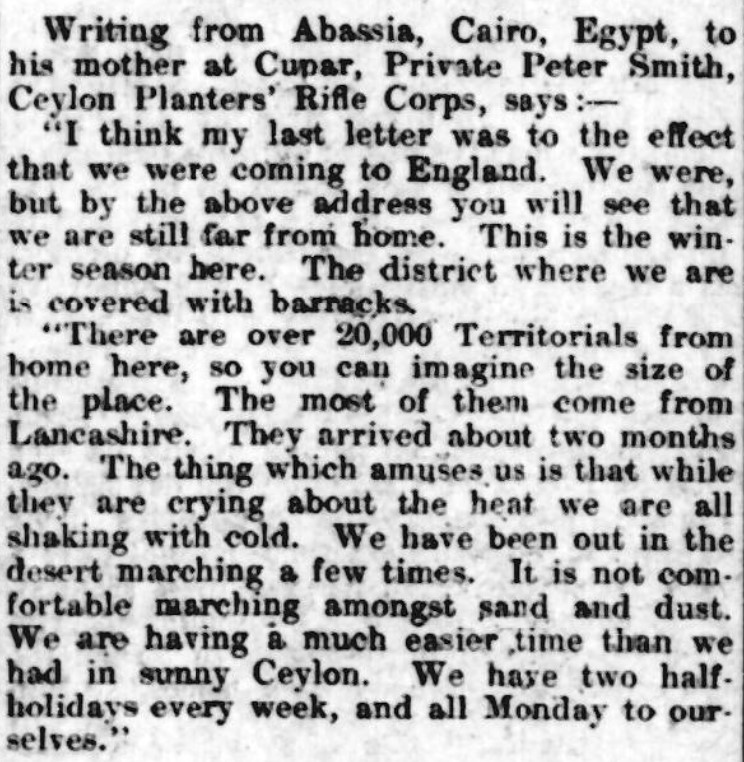
In early 1915 the Corps was deployed in defence of the Suez Canal, and in March of that year it lost a large number of its “originals” who left to be commissioned as officers.

During December 1914 it transferred to the Australian and New Zealand Army Corps (ANZAC) and was at first placed under the Wellington Battalion of the New Zealand forces. Its commanding Officer Lieutenant-Colonel William Malone would say of the contingent, “I had them over and inspected them and found them well-trained and really good hefty men. They all put their will into their work and every man uses his brains to do his bit thoroughly. They are alert and physically very fit. Their officers are really good. I wouldn’t mind swapping some of mine….”.
The contingent, reduced by the commissions, landed at Anzac Beach at the start of the Gallipoli campaign, acting as personal escort to the ANZAC commanding officer, Lieutenant-General William Birdwood. It would continue in this role throughout the campaign.


The active service element of the CPRC appears to have been disbanded after the Gallipoli campaign came to an end.
Research tips
Sadly, there appears to be no war diary for the Ceylon Planters Rifle Corps. Its men are listed in the British campaign medal rolls but I have never found a service record in British collections (unless the man was eventually commissioned as an officer of the British Army).
The Ceylon Planters Rifle Corps has an affiliation with the Rifle Brigade, a regiment whose archive is held at the Rifles Museum at Winchester. Whether it holds any relevant material is unknown to me but it may be worth an enquiry.